At its heart, a merger is about bringing two teams together. It might look simple at first — combine people, resources, and goals. However, the challenge lies in how those teams fit, who takes responsibility, and how decisions get made. These choices determine whether the combined organisation thrives or gets stuck handling friction in the corporate world.
So, what makes a merger succeed?
What often goes unnoticed is that every deal follows a specific structure with objectives and trade-offs. The better you understand the essentials, the more control you gain over risk and execution. In other words, picking the right structure is as crucial as choosing the right partner.
Keep reading to learn the following:
✔️ What is a merger?
✔️ Why do companies combine into one entity?
✔️ What are the main merger types?
✔️ How do mergers create value?
✔️ What’s the difference between a merger and an acquisition?
✔️ How do you choose the right deal?
What is a merger?
This is a strategic combination of two companies into a single legal and economic entity. Organisations usually merge to create synergies, expand market reach, and improve operational efficiency. Unlike acquisitions, this deal is agreed on by both companies, sharing decisions about the new organisation’s direction.
Quick overview: Key things to know about a merger
| Aspect | What it means | How it works |
| 1. Ownership and control | Changes who owns and runs the business | Shareholding and voting rights are adjusted to reflect contributions; leadership and board roles are restructured so both companies guide the combined operations |
| 2. Integration of operations | Brings together assets, teams, and processes | Resources are combined to increase efficiency, reduce duplication, and achieve scale; teams are aligned to work toward a shared strategy |
| 3. Legal and financial setup | Establishes a foundation for the new business entity | Legal structures and financial systems are aligned to ensure smooth operations, compliance, clear reporting, and effective execution of strategy |
Additional insights: See how dataroom providers secure sensitive information and accelerate deal execution.
Simply put, a merger is a carefully negotiated combination that creates a single company with shared control, integrated resources, and a unified plan.
Why do companies pursue mergers?
Common motivations include the following:
- Faster market access. Mergers provide immediate entry into new regions or customer segments without building a presence from scratch.
- Operational efficiency. Combining teams and processes reduces duplication and frees up resources for higher-value priorities.
- Competitive strength. Increased scale and market share improve brand position and pricing influence.
- Risk diversification. Broadly spread exposure across products, industries, or customer segments reduces reliance on one revenue source and supports cross-selling opportunities.
- Accelerated innovation. Access to technology, intellectual property, and specialist talent shortens development cycles and strengthens product pipelines.
Whatever the motivation, strategic combinations create a stronger, more resilient, and competitive organisation.
What are the different types of mergers?
The main deal forms include the following:
- Horizontal merger
- Vertical merger
- Congeneric (concentric) merger
- Market-extension merger
- Product-extension merger
- Conglomerate merger
Next, we break down each merger type, showing how it creates value, what risks are involved, and the main advantages and drawbacks.
1. Horizontal mergers
Goal: Increase market share and reduce competition
A horizontal merger occurs when two companies operating in the same industry and market combine to consolidate their position, achieve scale, and strengthen competitive advantage.
How the deal creates value:
- Operational efficiency. Eliminate duplicate functions such as production, sales, and back-office teams
- Revenue growth. Capture additional customers and expand market presence in overlapping regions
- Pricing leverage. Gain influence over pricing and industry standards, improving profit margins
- Innovation potential. Combine research and development efforts to accelerate product development and enhance offerings
Common risks:
- Regulatory intervention. Competition authorities may block the deal or require divestments due to reduced market competition.
- Integration friction. Combining overlapping teams, systems, and cultures can disrupt operations and delay synergies.
- Overestimated synergies. Cost savings and revenue gains may fall short if assumptions prove unrealistic.
- Customer backlash. Reduced competition can lead to price sensitivity or loss of trust among customers.
✅ Pros
- Larger combined market presence
- Lower per-unit costs at scale
- Stronger competitive positioning
✖️ Cons
- Heightened regulatory scrutiny
- Cultural clashes between similar teams
- Overreliance on a single market
👀Horizontal merger example
On 20 March 2019, The Walt Disney Company combined with 21st Century Fox in a US$71.3B transaction that changed the global media landscape. The deal gave Disney control over a vast library of film and television IP, expanding its content catalogue. At the time, both companies already ranked among the dominant players in the industry. So, the deal concentrated market power and scale.
2. Vertical mergers
Goal: Gain control over the supply chain and improve efficiency
A vertical merger happens when a company combines with another operating at a different stage of the supply chain to secure inputs, reduce costs, and enhance coordination.
How the deal creates value:
- Supply security. Ensure reliable access to key raw materials or distribution channels
- Cost optimisation. Reduce production and logistics costs through tighter coordination
- Margin improvement. Capture value previously held by suppliers or distributors
- Operational responsiveness. Streamline operations to respond faster to market changes
Common risks:
- Operational complexity. Managing businesses at different stages of the value chain increases coordination challenges.
- Loss of flexibility. Vertical integration can lock the company into specific suppliers or distribution models.
- Regulatory scrutiny. Authorities may raise concerns about market foreclosure or unfair competitive advantages.
- Execution risk. Poor alignment between upstream and downstream operations can erode expected efficiencies.
✅ Pros
- Greater control over critical inputs or distribution
- Improved coordination across operations
- Reduced exposure to supplier or distributor risk
✖️ Cons
- Reduced flexibility in sourcing or sales
- Capital tied up outside core competencies
- Antitrust concerns in concentrated markets
👀Example
Amazon acquired Whole Foods for $13.7 billion to move closer to the consumer in grocery retail. The deal linked Amazon’s logistics, data, and technology with physical stores and food sourcing, strengthening last-mile distribution and customer access.
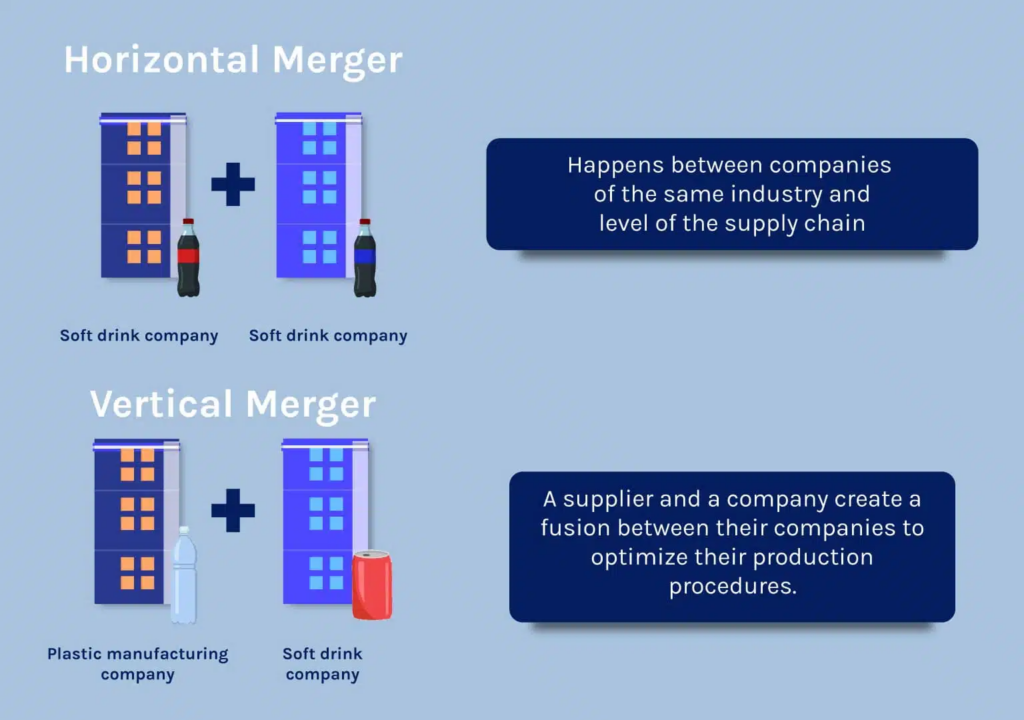
Source: Horizontal Mergers: How They Work and Real-life Examples
3. Congeneric (concentric) mergers
Goal: Expand offerings to shared customers
A congeneric merger occurs when two companies serving similar customers but offering complementary products or services combine to broaden capabilities, enhance customer relationships, and enable cross-selling.
How the deal creates value:
- Cross-selling opportunities. Offer complementary products or services to existing customers
- Shared channels. Leverage marketing and distribution networks efficiently
- Customer loyalty. Strengthen retention by providing broader solutions
- Combined expertise. Merge specialised teams to innovate faster
Common risks:
- Integration misalignment. Complementary products may still require significant effort to align systems and teams.
- Diluted focus. Expanding offerings can distract management from core revenue drivers.
- Cross-selling challenges. Sales teams may struggle to effectively sell broader solutions without retraining.
- Brand confusion. Customers may not immediately understand the combined value proposition.
✅ Pros
- Deeper engagement with existing customers
- Broader solution set within a defined market
- Knowledge sharing across adjacent capabilities
✖️ Cons
- Complexity in aligning product strategies
- Limited economies of scale on the cost side
- Risk of unclear market positioning
4. Market-extension mergers
Goal: Enter new geographic or demographic markets quickly
A market-extension merger occurs when a company combines with another that offers the same product but operates in a different region or market segment for rapid expansion without building infrastructure from scratch.
How the deal creates value:
- New customer access. Enter previously untapped regions or demographics
- Distribution leverage. Use existing networks to accelerate market entry
- Brand growth. Increase visibility and recognition in new markets
- Operational efficiency. Benefit from economies of scale across regions
Common risks:
- Cultural and regulatory barriers. Differences in local regulations, consumer behaviour, or business norms can slow expansion.
- Overreliance on local performance. Weak performance in the new market can undermine the deal’s rationale.
- Integration delays. Aligning operations across regions often takes longer than expected.
- Brand transfer risk. A strong brand in one market may not resonate in another.
✅ Pros
- Faster entry into new geographic markets
- Immediate access to local market knowledge
- Revenue growth without product redesign
✖️ Cons
- Exposure to unfamiliar regulatory environments
- Integration challenges across regions or cultures
- Uneven performance across markets
5. Product-extension mergers
Goal: Broaden product portfolio for existing customers
A product-extension merger occurs when two companies with related but distinct products combine to serve the same customer base more comprehensively, enhancing offerings and enabling cross-selling opportunities.
How the deal creates value:
- Cross-selling. Introduce complementary products to the existing customer base
- Shared channels. Use the same sales and distribution networks efficiently
- Customer satisfaction. Strengthen loyalty with a more complete product offering
- Innovation synergy. Combine research and development efforts to create integrated solutions
Common risks:
- Product overlap. Poor differentiation can lead to internal competition between offerings.
- Complex product integration. Linking related products may require more technical effort than planned.
- Unclear customer value. Customers may not immediately see the benefit of the expanded portfolio.
- Innovation slowdown. Integration demands can temporarily divert focus from research and development execution.
✅ Pros
- Expanded product choice for existing customers
- Stronger customer retention through bundled offerings
- Incremental revenue from the same sales base
✖️ Cons
- Increased complexity in product management
- Dilution of focus on core offerings
- Uneven demand across the product portfolio
👀Example
In 2000, Glaxo Wellcome and SmithKline Beecham merged to form GlaxoSmithKline (GSK). Both served similar pharmaceutical markets, but their products were complementary. Glaxo specialised in vaccines and respiratory treatments. SmithKline Beecham, in turn, focused on consumer health and oncology. The deal expanded the combined product portfolio for the same customers and strengthened global market reach.
6. Conglomerate mergers
Goal: Diversify business and reduce dependency on one industry
A conglomerate merger occurs when companies from unrelated industries combine to spread risk, expand investment opportunities, and achieve financial growth outside their core business.
How the deal creates value:
- Earnings stability. Diversify across unrelated industries to reduce revenue volatility
- Risk reduction. Spread operational and financial risk across sectors
- Growth opportunities. Access new markets and investment avenues
- Capital allocation. Allocate resources efficiently across different businesses
Common risks:
- Strategic dilution. Managing unrelated businesses can weaken strategic clarity and leadership focus.
- Limited synergies. Financial diversification often replaces operational synergy, reducing value creation potential.
- Capital misallocation. Resources may shift toward weaker units instead of core strengths.
- Investor scepticism. Markets may discount conglomerates due to complexity and reduced transparency
✅ Pros
- Reduced dependence on a single industry
- More stable earnings across business cycles
- Broader capital allocation opportunities
✖️ Cons
- Limited operational synergies
- Management stretch across unrelated businesses
- Valuation discounts due to complexity
️🗨️ The table below presents a high-level comparison of the main merger types, showing how they differ in business relationships, strategic goals, and integration focus.
| Type | Business relationship | Products or services | Market focus | Integration focus | Typical risk area |
| 1. Horizontal merger | Direct competitors | Same or very similar | Same market | Operations, pricing, market positioning | Regulatory scrutiny, overconsolidation |
| 2. Vertical merger | Buyer–supplier | Different but linked | Same value chain | Supply chain, processes | Operational complexity |
| 3. Congeneric (concentric) merger | Related businesses | Complementary | Same or overlapping customers | Sales, cross-selling, product alignment | Integration execution |
| Market-extension merger | Similar businesses | Same products | New geographic market | Distribution, local operations | Regulatory and cultural fit |
| Product-extension merger | Related businesses | Related but distinct | Same market | Product, branding, customer experience | Product overlap confusion |
| Conglomerate merger | Unrelated businesses | Unrelated | Different markets | Financial oversight, governance | Strategic dilution |
Additional insights: Check how a data room for due diligence helps dealmakers organise documents, verify information quickly, and reduce risk in any type of merger.
These deal types cover the most common ways companies merge to grow, compete, and diversify. However, there are additional, more specialised transaction structures used to address specific strategic, regulatory, and financial objectives.
What are other forms of merger?
Beyond strategic intent, companies also categorise the transactions by their legal and structural forms. This layer matters because the structure determines how ownership transfers, which liabilities move with the business, and how complex the integration becomes. In many cases, the legal form drives risk, cost, and speed more than the strategic label does.
Several common structures dealmakers rely on include the following:
1. Statutory merger
One company legally absorbs another, and the acquired entity ceases to exist. All assets, liabilities, rights, and obligations transfer automatically to the surviving company under statute. This is one of the most straightforward structures, but it offers limited flexibility if parties want to isolate risk.
2. Consolidation
Two or more companies combine to form one new legal entity, while the original companies dissolve. Shareholders receive equity in the new organisation. Consolidations often signal a “true combination” but require more extensive legal and operational coordination.
3. Triangular merger
The transaction runs through a subsidiary rather than directly between the two main companies. This structure allows the acquirer to limit liability exposure and preserve existing contracts. It is common in cross-border and large corporate deals.
4. Reverse merger
A private company combines with a publicly traded company, allowing the private business to become publicly listed without a traditional initial public offering. While often discussed separately from classic M&A, reverse mergers remain an important transaction type in capital markets.
5. Asset acquisition vs share acquisition
Instead of combining entities, a buyer may purchase selected assets or acquire shares of a company.
- Asset acquisitions allow buyers to pick specific assets and avoid unwanted liabilities.
- Share acquisitions transfer ownership of the entire company, including contracts, employees, and obligations.
These legal structures often intersect with strategic merger types. Understanding both perspectives helps explain how deals work and why similar transactions can carry different risks and outcomes.
For example, a company may pursue a market-extension merger by entering a new country through a share acquisition, inheriting the local entity’s contracts and liabilities. The same goal could be achieved through an asset acquisition, where only selected assets are transferred and legacy risks stay behind.
Mergers vs acquisitions: Key differences
Mergers and acquisitions often appear together under the term M&A, but they describe different deal dynamics.
While a merger happens when two companies combine as equals to form a new or blended entity, an acquisition occurs when one company buys another. In an acquisition, the buyer sets the terms, often integrating the acquired company into its existing operations, culture, and business strategy.
At a glance: key merger vs acquisition differences
| Aspect | Merger | Acquisition |
| Control and ownership | Ownership is shared between the combining parties | One company takes control of another |
| Legal structure | Two entities combine into one | One entity absorbs or purchases the other |
| Power dynamics | Negotiated, often balanced | Buyer dictates terms |
| Branding and identity | A new or blended brand may emerge | A target company’s brand may stay or be absorbed |
| Integration approach | Joint integration of leadership and operations | Integration driven by the acquiring company |
| Financial responsibility | Liabilities and assets are shared | Buyer assumes the majority of liabilities and assets |
| Decision-making | Shared governance | Decisions made primarily by the acquiring company |
| Employee impact | Usually collaborative, but role adjustments occur | More likely to involve restructuring or layoffs |
| Cultural alignment | Requires negotiation of cultures | One culture dominates |
Note: The table shows clear differences between mergers and acquisitions. However, real-world deals often blend characteristics of both transaction types. For example, some “mergers” may function like acquisitions in terms of control, while certain acquisitions resemble mergers in how parties integrate leadership and operations.
Additional insights: Learn more about the merger and acquisition process.
How to choose the right type of merger?
No merger type is universally “best.” The right choice depends on a company’s goals, market position, and resources. Executives and investors weigh multiple factors to ensure the deal creates value.
Here’s a quick guide to the main considerations:
1. Identify your main goal
- Growth in the same market → consider horizontal mergers
- Control over supply or efficiency → consider vertical mergers
- Broaden offerings to the same customers → consider product-extension or congeneric mergers
- Enter new markets → consider market-extension mergers
- Diversify into unrelated industries → consider conglomerate mergers
2. Check market conditions
- Rapidly growing or competitive markets → favors mergers that increase market share or capabilities quickly
- Stable or declining markets → diversification or operational efficiency may matter more
3. Assess financial capacity
- Large budgets and resources → can pursue complex mergers
- Limited capital → simpler deals or partnerships may be safer
4. Consider the regulatory environment
- High regulatory scrutiny → some merger types (like horizontal) may be harder to approve
- Low scrutiny → more freedom in choice
5. Evaluate integration complexity
- Easy cultural and operational fit → large-scale mergers possible
- High complexity → start with deals that have clear synergies
This framework is a starting point, not a strict rule. Most real-world mergers combine elements of different types, and circumstances like company culture, competitive pressures, or unexpected costs can shift the best option. So, use this map to narrow down choices, identify potential risks, and guide discussions with advisors or executives. Then, evaluate each deal in more detail before making a decision.
Conclusion
Different merger types show how business entities combine and what each structure can achieve. They clarify the roles of the companies involved, highlight potential risks, and reveal how deals create value. Most importantly, they demonstrate how transactions can help gain market share, expand capabilities, and strengthen competitive positioning. This insight equips executives, investors, and advisers to make smarter strategic, financial, and investment decisions.